

Our team has compiled a list of educational resources and links to help inform and support our patients on each type of treatments we provide.
What is SVT? What is Atrial Tachycardia?
SVT stands for Supraventricular Tachycardia. In simple terms, SVT is a condition where your heart sometimes beats unusually fast. It’s usually not a sign of serious heart disease, and many people with SVT have otherwise healthy hearts.
There are two main types of SVT:
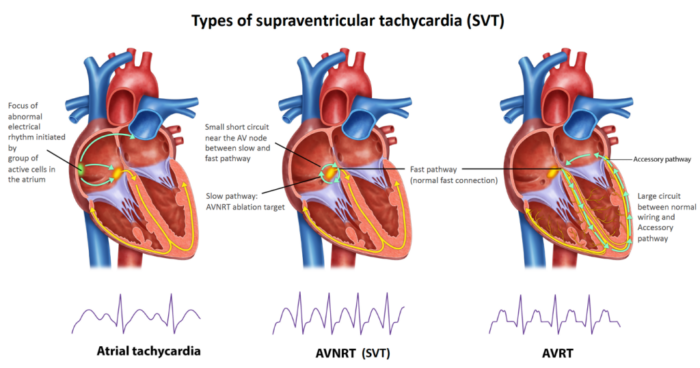
One is due to a mechanism called “reentry”. In this reentrant SVT, there’s a “short circuit” in the electrical system, in the upper chambers of your heart. This “short circuit” occurs because sometimes people are born with an extra circuit in their heart. Most common type is when your main circuit, AV node, is split into two circuits, fast pathway and slow pathway (AVNRT). Extra circuit can also be an “accessory pathway” located away from your main circuit, AV node (AVRT; Wolff-Parkinson-White Syndrome/WPW). This short circuit cause your heart to suddenly speed up, beating much faster than it normally would, often over 100 beats per minute, and sometimes much higher.
The second type is called “Atrial Tachycardia“. In this atrial tachycardia, small area in the upper chamber of the heart (right or left atrium) “misfires”, leading to a sudden increase in heart rate.
What does it feel like?
- Your heart pounding or racing (palpitations)
- Dizziness or lightheadedness
- Shortness of breath
- Chest discomfort
- Feeling anxious or uneasy
These episodes can start and stop abruptly and usually last from a few minutes to several hours.
What tests are needed to diagnose SVT?
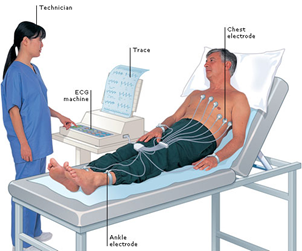
- ECG: This is typically performed in a doctor’s office, urgent care, emergency department, or hospital setting. Small electrodes (stickers) are placed on your chest, arms and legs, then a 12-lead ECG/EKG is recorded.
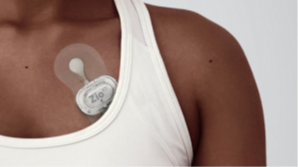
- Ambulatory Monitor: A small patch about the size of your palm is placed on your chest for 2-4 weeks to record rhythm continuously. You can take a shower, and carry on most activities while wearing this monitor, although swimming should be avoided.
-
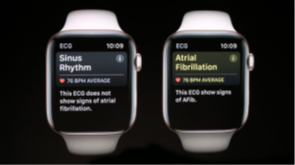
- Apple Watch/Kardia/Fitbit/Android smartwatch/other wearable monitors can be very helpful in documenting SVTs because these tend to be random in occurrence, often many weeks to months apart to be able to capture it by wearing a 2–4-week ambulatory monitor. By having a wearable monitor available, you can capture an episode during a typical 30 second wearable monitor recording period.
How can we treat SVT?
The good news is that SVT is very treatable! Here are some common approaches:
- Vagal Maneuvers
- Medications
- Ablation Procedure
Vagal maneuvers:
Vagal maneuvers are simple physical actions that can help slow down your heart rate if it’s beating too fast. They work by stimulating the vagus nerve, which plays a key role in regulating your heart rate and other involuntary bodily functions.
Examples include:
- Bearing down as if having a bowel movement (called the Valsalva maneuver)
- Gagging
- Splashing cold water on your face
Your doctor or nurse can teach you how to perform these safely and effectively.
Here are a few common vagal maneuvers:
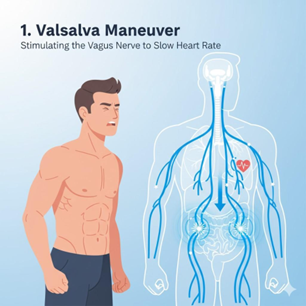
- Valsalva Maneuver: This is one of the most frequently used vagal maneuvers. To perform it, you take a deep breath in, then bear down as if you are having a bowel movement. This increases pressure in your chest and abdomen, which in turn stimulates the vagus nerve.
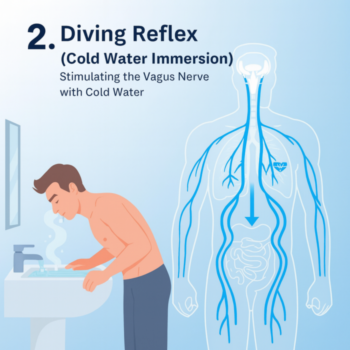
- Diving Reflex (Cold Water Immersion): This maneuver involves immersing your face in cold water. Sudden exposure to cold water triggers a reflex known as the “diving reflex”, which automatically slows down your heart rate and constricts blood vessels. 
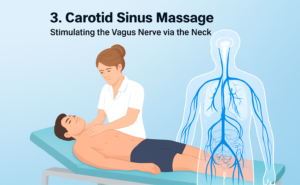
- Carotid Sinus Massage: This maneuver involves gently massaging the carotid sinus, an area in the neck where the carotid artery branches. The carotid sinus contains baroreceptors that detect changes in blood pressure. Massaging this area can trick the body into thinking blood pressure is high, leading to a reflex slowing of the heart rate via the vessels.  nerve. This maneuver should only be performed by a healthcare professional due to the risk of complications. 
Medications: Helping Your Heart Stay in Rhythm
If vagal maneuvers do not work, or if your SVT episodes are frequent, your doctor might prescribe medication.
These are called antiarrhythmic medications, and they work by:
- Slowing down your heartrate during an episode.
- Helping to prevent future episodes by stabilizing your heart’s electrical system.
It’s important to take these medications exactly as prescribed and discuss any side effects with your doctor.
- Beta-blockers and Calcium Channel Blockers: These are often the first medications doctors try. They work by slowing down part of your heart’s electrical conduction system which helps to prevent extra circuits from acting up. They are often used to treat high blood pressure as well.
- Other Anti-Arrhythmic Medications (e.g. Flecainide, Sotalol, Amiodarone): If the first-line medications are not effective, your doctor may recommend stronger drugs.
These medications specifically work on the electrical system of the heart to prevent extra circuits from acting up.
Important Note: These medications can have serious side effects and are usually reserved for frequent or highly symptomatic PACs. Your doctor will carefully weigh the benefits against the risks.
- Beta-blockers
- Metoprolol succinate (Toprol), Metoprolol tartrate (Lopressor), Atenolol (Tenormin)
- Beta-blockers slow your heartrate and lower your blood pressure (often used as a blood pressure control agent)
- Potential side effects can be fatigue, shortness of breath (especially if you have history of lung problems such as asthma or COPD (Chronic Obstructive Pulmonary Disease), dizziness/lightheadedness, especially if it slows down your heartrate or lowers your blood pressure too much. At higher doses, some may experience weight gain, erectile dysfunction, and depression.
- Metoprolol succinate (Toprol), Metoprolol tartrate (Lopressor), Atenolol (Tenormin)
- Calcium channel blockers
- Diltiazem (Cardizem), Verapamil (Calan)
- Calcium channel blockers also lower your blood pressure (often used as a blood pressure control agent)
- Potential side-effects include ankle/feet swelling, constipation, dizziness/lightheadedness, especially if your blood pressure gets too low.
- Diltiazem (Cardizem), Verapamil (Calan)
- Sodium channel blockers
- Flecainide (Tambacor), Propafenone (Rythmol)
- These medications can cause dangerous rhythm called ventricular tachycardia in patients with heart disease, so every patient needs to be screened for any heart disease before starting these medications and will need to repeat screening tests periodically.
- These medications are usually very well tolerated, but at times can cause side effects such as dizziness, lightheadedness, headache, upset stomach, metallic taste (propafenone), among other side-effects.
- Flecainide (Tambacor), Propafenone (Rythmol)
- Potassium channel blockers
- Sotalol (Betapace, Dofetilide, Tikosyn), Dronedarone (Multaq), Amiodarone (Cordarone)
- These medications can sometimes slow down your heartrate too much and are usually not used in patients whose heartrate is already slow at baseline (e.g. less than 60 beats per minute).
- These medications can also rarely cause a dangerous arrhythmia called ventricular tachycardia/Torsade’s de pointe. This is more likely for patients with very slow heartrates or who have underlying structural heart disease. It rarely occurs if you are screened and monitored appropriately. ECG needs to be monitored before and after starting these medications to make sure there is no abnormal change (QT prolongation). For this reason, some of these drugs (e.g. dofetilide) require hospitalization for 2-3 days for initiation of the medication so that you can be monitored closely.
- Amiodarone is by far the most effective rhythm controlling medication that we have. However, it has several potentially serious side-effects and toxicities, especially when used at a higher dose for extended periods. This medication requires close monitoring routine blood testing, chest x-ray, eye exam, and close follow-up visits. When used properly, this can be an immensely helpful medication for patients with refractory or advanced stages of atrial fibrillation. Amiodarone can cause sensitivity to the sun. When taking amiodarone, you should use strong sunscreen and consider wearing a hat and long sleeves when possible.
- Sotalol (Betapace, Dofetilide, Tikosyn), Dronedarone (Multaq), Amiodarone (Cordarone)
Catheter Ablation: A Long-Term Solution
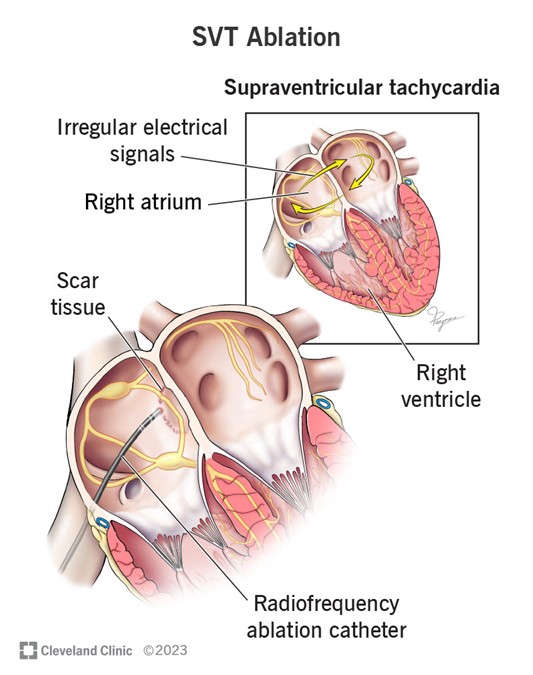
For many people, catheter ablation offers a long-term, and often permanent, solution for SVT. Ablation is a common and safe procedure that has a high success rate in curing SVT.
Here’s a simplified look at how ablation works:
- Preparation: Before the procedure, you’ll be given medication to help you relax. The doctor will clean and numb a small area, usually in your groin, where they’ll insert thin, flexible wires called catheters.
- Mapping the Heart: The catheters are carefully guided through your blood vessels up to your heart. These catheters have tiny sensors that can receive your heart’s electrical signal. The doctor uses these sensors to create a detailed electrical map of your heart, pinpointing exactly where that problematic “short circuit” or extra pathway is located.
- Ablation: Once the troublesome spot is identified, a special catheter is used to deliver a small amount of radiofrequency energy to that area. This energy is a type of heat, like the energy used in a microwave oven, but delivered in a very precise and controlled way. This heat creates a tiny scare, which effectively “burns” and closes off the extra electrical pathway. It’s permanently sealed off that detour road, so the electrical signals can no longer get stuck there.
- Confirmation: After the ablation, the doctor will re-check your heart electrical activity to make sure the “short circuit” is gone, and your heart rhythm is back to normal.
The whole procedure usually takes 1-2 hours, and most people can go home the same day or the next. It’s a very effective treatment for SVT, helping many people get rid of their fast heartbeats and enjoy a normal, healthy rhythm again.
Living with SVT
- Talk to your doctor: Discuss your symptoms, how often they occur, and how they affect your life.
- Know your triggers: Some people find certain things, like caffeine, alcohol, stress, or lack of sleep, can trigger SVT episodes.
- Stay informed: Understanding your condition helps you manage it better.
Your healthcare team is here to help you understand your SVT and find the best treatment plan for you. Don’t hesitate to ask questions!